
The Small Nonprofit's Guide to Form 990: Which One, When, and How to Stop Dreading It
Which 990 your nonprofit files, when it is due, what happens if you miss it, and how to gather everything before tax season. Includes a free prep worksheet.

Jenn Howe
Nearly 30 years working in and consulting for nonprofits
Every spring the same question shows up in nonprofit forums: where can a small organization file its 990-EZ online without paying hundreds of dollars? Someone asked it six years ago. Someone asked it again this July, and again in September. The answers are always a few brand names and not much else, which tells you two things. Small nonprofits are still doing this on their own with no budget, and nobody has written down the whole picture for them.
Small organizations do this filing on their own every year, and some of them discover a problem the hard way. This post is the walkthrough I wish they had been handed at the start.
Why the 990 matters more than it feels like it should
The Form 990 is the annual information return every tax-exempt organization files with the IRS. Unlike a tax return, there is usually no tax to pay. What you are doing is proving you still exist, still operate for the purpose you were granted exemption for, and still keep reasonable books.
Three things make it more consequential than a formality.
It is public. Your 990 is posted on the IRS site, on Candid, and on ProPublica's Nonprofit Explorer, where any funder, journalist, donor or board candidate can read it. A funder doing due diligence will often read your 990 before they read your proposal. Program descriptions written in a hurry, a board list that is two years stale, or expenses that look odd next to revenue all get noticed.
It is how you keep your exemption. If an organization fails to file for three consecutive years, the IRS revokes its tax-exempt status automatically. There is no warning letter you can argue with and no appeal. Donations stop being deductible, grants become ineligible, and reinstatement means reapplying and paying the fee. This happens to small, well-meaning organizations every year, usually because the person who used to file it left.
It is where your board's oversight gets recorded. The full form asks directly whether the board reviewed the return before it was filed. Even on the shorter forms, the 990 is the one document that forces a once-a-year look at the whole organization: money in, money out, who governs, what you accomplished.
Which form you file
This is the question most people get wrong at least once, so here is the plain version. The thresholds are based on gross receipts (everything that came in before expenses) and, for the EZ, total assets.
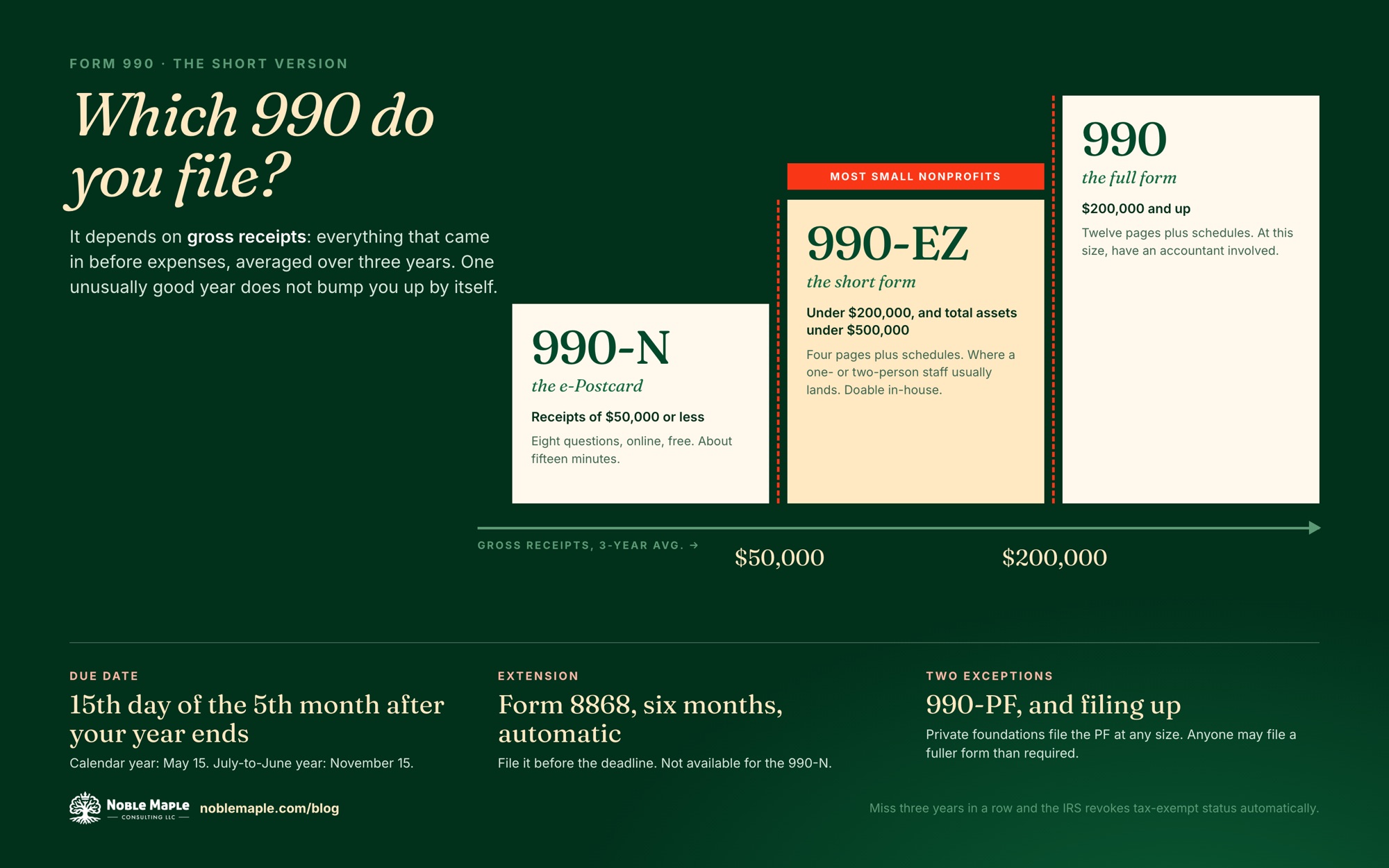 The short version. Thresholds use a three-year average of gross receipts. Click to open full size.
Form 990-N, the e-Postcard. For organizations whose gross receipts are normally $50,000 or less. It is eight questions, filed online directly with the IRS, and takes about fifteen minutes once you have the information. There is no paper version and no fee.
Form 990-EZ. For organizations with gross receipts under $200,000 and total assets under $500,000. Four pages plus schedules. This is where most small nonprofits with a staff member or two land, and where the "how do I file this without paying hundreds" question comes from.
Form 990. Everyone above those thresholds. Twelve pages plus schedules, and at this size you should have an accountant involved.
Form 990-PF. Private foundations only, regardless of size.
Two notes on the thresholds. "Normally" has a specific IRS meaning involving a three-year average, so an unusually good year does not automatically bump you up. And you are always allowed to file a more complete form than required. Some organizations file the EZ even when they qualify for the postcard because funders want to see financials.
When it is due
The 990 is due on the 15th day of the fifth month after your fiscal year ends. For a calendar-year organization that is May 15. For a July-to-June fiscal year it is November 15.
You can get an automatic six-month extension by filing Form 8868 before the deadline. The extension is routine and nobody at the IRS thinks less of you for it. What you cannot do is extend a 990-N, and you cannot file any 990 late without penalty if you did not request the extension.
Penalties for filing late with no extension are charged per day and scale with the organization's size. More to the point, a late filing counts as a missed year toward the three-year revocation clock if it never gets filed at all.
Where to file
All 990s must be filed electronically now, including the EZ. The 990-N is filed for free through the IRS's own system. For the EZ and the full 990, the IRS publishes a list of approved e-file providers, and prices range from free or very low cost for simple EZ filings to several hundred dollars for software aimed at accountants. If you are using a bookkeeper or accountant, they will file through their own software. If you are doing it yourself, start from the IRS provider list rather than a search engine, because the ads at the top of search results are not always the cheapest or most appropriate option.
What the form actually asks, in the order you should gather it
Most of the dread around the 990 comes from opening the form cold in April. The information it asks for is not hard to assemble if you start in January, and almost all of it already exists somewhere in your organization.
Organizational basics. Legal name, EIN, address, fiscal year, state of incorporation, website, the name and contact for the person filing. Your exemption determination letter, if you can find it.
Financial summary. Total revenue broken out by contributions, program service revenue, investment income, fundraising event income (gross and net), and other. Total expenses broken out by program, management, and fundraising. Beginning and end-of-year net assets. This should come straight from your year-end financial statements, which is a good reason to close the books before you open the form.
Program accomplishments. A short narrative for each major program: what you did, how many people you served, what it cost. This is the part funders actually read, and it is almost always written too fast. Draft it in January from your real program data and have someone outside the program read it.
Governance. The list of officers, directors and key employees, with hours per week and any compensation. The form also asks whether you have a conflict of interest policy, a whistleblower policy, and a document retention policy, and whether the board reviewed the 990. Answering no to those is legal. It is also visible to everyone who reads the return.
Schedules. The EZ and the full form attach schedules depending on your answers. Schedule A (the public support test, which proves you are a public charity rather than a private foundation) applies to nearly everyone. Schedule B lists large donors and is not made public. Schedule O is where you explain anything the main form did not give you room for. Schedule G covers fundraising events above certain thresholds.
Compensation. For the full 990, compensation of officers and highest-paid employees, and whether the board approved it using comparable data. For small organizations this is usually a single line, but it is a public line.
The habit that makes next year easy
The organizations that stop dreading the 990 are the ones that treat it as the last step of closing the year rather than a separate event. Close the books in January. Pull the governance information and program numbers in February. Have the board review a draft at the March or April meeting. File in May, or file the extension in May and finish over the summer without panic.
If you are a new ED or treasurer, there is one more step: go to the IRS Tax Exempt Organization Search and confirm your organization's filings are current. More than one new leader has found out that way that a year had been missed.
A worksheet to gather it all
I built a Form 990 Prep Worksheet for the small organization that does this without an accountant, or with an accountant who charges by the hour for every question. It walks through every piece of information the 990-N, 990-EZ and core 990 ask for, in gathering order, with space to record where each number came from and who confirmed it. There is a short section on writing program accomplishments that funders will actually read, and a filing calendar you can adapt to your fiscal year.
Work through it once and you will have most of next year's answers already written down. That is the whole point.
Want help with this?
I work with small nonprofits and small businesses on their websites and the systems behind them. The first call is free, and there is no pitch.
Book a free 20-minute call →