
The Grant Report Was Due Yesterday, and Other Preventable Emergencies
Grant reports get written in a last-minute scramble because nothing was set up at award time. Here is the system that fixes it, and a template to start.

Jenn Howe
Nearly 30 years working in and consulting for nonprofits
A new executive director posted recently asking other EDs to share their worst mistakes, and offered her own first: she had missed a grant deadline. In a separate thread, staff at a five-person organization described an ED who was losing grants because she kept missing deadlines, and were weighing whether to go to the board about it. Those are two posts out of many, and I am not sharing them to pile on. Missing a grant deadline at a small nonprofit is almost never a character flaw. It is what happens when the grant lives in one person's inbox and nowhere else.
How most small organizations actually handle grants
The award letter arrives and everyone is relieved. Someone saves it to a folder, or forwards it to the bookkeeper, or both. The reporting dates in the agreement get noted somewhere, maybe on a calendar, maybe in a spreadsheet that one person maintains. Then the program starts, the year gets busy, and nine months later an email from the funder reminds you a report is due in two weeks.
What follows is the scramble. Someone digs out the original proposal to remember what was promised. Someone else chases the program staff for numbers they have not been tracking in the form the funder wants. The bookkeeper is asked for a spend-down by budget line, which takes a day because the grant was never set up as its own class in the accounting software. The ED writes the narrative the night before, from memory.
This pattern is so common that one grants software company describes staff being stuck in a loop of spreadsheets, email chains and scattered files, with each funder wanting a different format and reports assembled at the last minute. A Stanford Social Innovation Review piece this spring estimated a single proposal takes anywhere from two days to four weeks, and that re-entering the same organizational information across forty applications a year eats about half a work week by itself. The same piece pointed out that grant work usually lands on program or executive staff who already have full jobs.
And this is at the organizations that have not been hit by cuts. Instrumentl surveyed more than 300 grant-seeking nonprofits last fall and found 47 percent had lost federal, state or local grant money during the year. Eight in ten of those were pivoting toward private and corporate funders, which means more applications, more reports, and more funders with their own formats, all at once.
Why the report is the easy part
If there is one thing to take from this post, it is that most of the work of a grant report happens, or fails to happen, in the three or four hours after the award letter arrives. Set the grant up properly then and the report nine months later is mostly a matter of filling in numbers you already have.
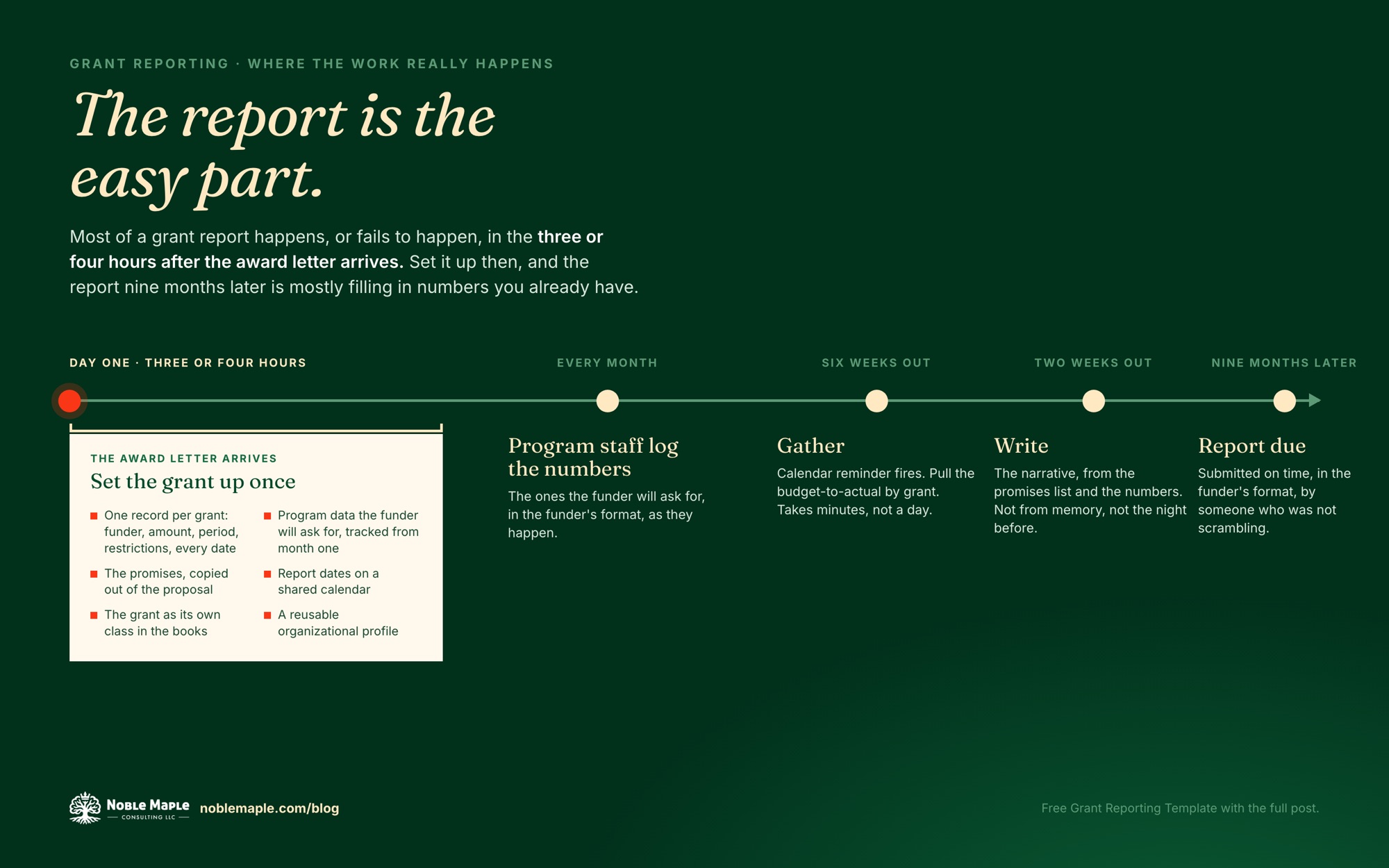 Where the work really happens: day one, not the week the report is due. Click to open full size.
Here is the setup I recommend. Every grant gets the same treatment on the day the award letter arrives.
One record per grant, in one place. Funder, amount, period, program, restrictions, the person responsible, and every date in the agreement: report due dates, payment dates, any site visit or check-in. A spreadsheet is fine for this if it is the only spreadsheet. The failure mode is three partial spreadsheets plus the ED's memory.
The promises, pulled out of the proposal. Every grant proposal contains commitments: numbers served, outcomes, activities, a timeline. Those get copied into the grant record at award time, in a short list, so the person writing the report in nine months does not have to reverse-engineer them from a twelve-page narrative.
Program data the funder will ask for, collected from month one. If the funder wants the number of participants who completed the program, program staff need to know that on day one and track it monthly. Most reporting scrambles happen because the question was first asked at reporting time.
The grant as its own line in the books. Set it up as a class, fund or project in your accounting software the week the money arrives. Then a budget-to-actual report by grant takes minutes instead of a day of reconstruction. This is also what keeps restricted money from drifting into general operations, which is a far more expensive mistake than a late report.
Dates on a shared calendar, with lead time. Every report date goes on a calendar the whole team can see, with a reminder six weeks out and another at two weeks. The six-week reminder is for gathering data. The two-week one is for writing.
A reusable organizational profile. Mission, history, board list, budget summary, EIN, key staff bios, audited financials. One document, updated twice a year, that anyone can pull from. This is the half a work week the SSIR piece was describing, and it is the easiest time to get back.
What this looks like in a three-person shop
I want to be realistic about capacity. A small organization is not going to adopt a grants management platform, and it should not. The system above fits in a spreadsheet, a shared calendar, a folder structure, and a two-page template for the report itself. The discipline is in doing the setup at award time instead of at report time, and in agreeing as a team that the grant record is the one source of truth.
If you are inheriting someone else's grants, the first job is simply to build the list. Pull every active award letter, read each agreement for dates and conditions, and get them into one record. This is usually the moment a new ED finds a report that was due last month.
A template to start from
I built a Grant Reporting Template for the person who has to write these reports with no system behind them. It gives you a structure that works across most funders (what was promised, what happened, what the numbers show, what the money was spent on, what changed and why), with guidance on how to write each section so you are answering the funder's actual question rather than filling space. It also includes the award-time setup checklist from this post, so the next report is easier than this one.
If grants are a big enough part of your budget that you need the full system, the Grant Management Toolkit covers the pipeline, the tracker, the reporting calendar, and the organizational profile together. The template is the place to start if you have a report due and no time.
Want help with this?
I work with small nonprofits and small businesses on their websites and the systems behind them. The first call is free, and there is no pitch.
Book a free 20-minute call →